The Citizens Band Radio Service, or CB, as it is commonly called, is a type of radio communication under the category of Personal Radio Service. As with the other types of PRS, such as FRS, GMRS, MURS, and LPRS (Low Power Radio Service), CB is intended for both consumer and business use. CB is covered under Part 95 of the FCC rules. A CB radio does not require a license to operate.
CB service operates on 40 shared channels in an AM mode or Single SideBand (SSB) mode. SSB offers less noise and greater range than AM mode and is usually found on higher end CB radios. SSB has two modes, Upper Sideband and Lower Sideband. You can only communicate with other SSB CB radios when in SSB mode.
There is no minimum age requirement to operate a CB radio. In fact. almost anyone can use CB. According to the FCC rules (95.403) "you are authorized to operate a CB station unless:
(a) You are a foreign government, a representative of a foreign government, or a federal government agency; OR
(b) The FCC has issued a cease and desist order to you, and the order is still in effect."
CB channels and frequencies are not assigned to any specific individual or organization. For the most part, you can operate a CB radio on all 40 channels and frequencies designated by the FCC for CB, but there are some caveats.
First, you can use CB only on those 40 channels and frequencies. Channel 9 may be used only for emergencies or for travel In addition, however, any channel can be used for emergency communications or traveler assistance. In addition, as these channels are shared, you must always give priority to emergency communications on all channels.
The maximum power levels for CB operation depends on the type of signal you are transmitting. AM signals are allowed a maximum of four watts. SSB mode is allowed up to 12 watts Peak Envelope Power, or PEP. According to the FCC, you are not allowed to raise the power output of your CB unit, attach any type of power amplifier, or modify the unit internally. Also, according to the FCC, you must use an FCC-certified CB unit in the United States. FCC-certified CB units have an FCC-certified label placed on the radio by the manufacturer.
CB is intended for short range, local communications only, but there is a way to increase range considerably by bouncing or "skipping" the signal off the ionosphere. This method is called 'shooting skip". Some CB users can skip a signal thousands of miles. The FCC prohibits attempts to communicate with CB stations over 155.3 miles (250km) away; however, signals can skip naturally depending on tropospheric conditions, so it is not unusual to send or receive CB transmissions across the country - or even around the world - unintentionally.
Because the 40 CB channels are shared with other users, some common etiquette is required. users must never talk with another station for more than 5 minutes continuously and must wait at least one minute before starting another communication. In the early days of CB the FCC did require users to have a license and a call sign. While neither is no longer necessary, it is still common practice to have a "call sign" in the form of a pseudonym, or CB "handle". The FCC allows users to create their own handles.
CB users also have their own lingo and codes. 10 Codes are the universally accepted standard for CB transmission in AM mode while Q Signals are generally used for Single Side Band and by skip-talkers. For more information, download our FREE list of CB 10 Codes and Q Signals.
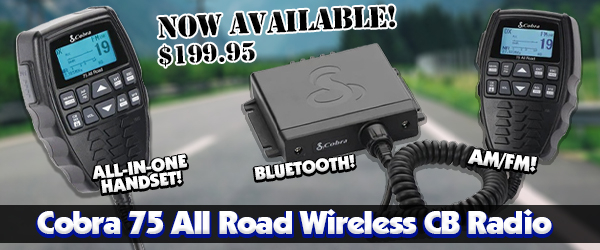
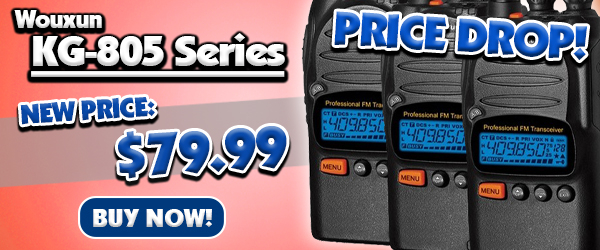
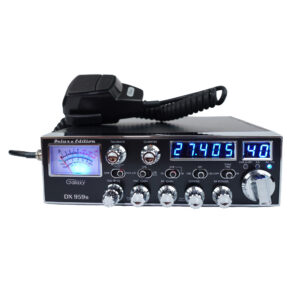
CB radio equipment is also standard. Popular brands include Cobra, Galaxy, Midland, President, Uniden and Wouxun. Cobra is one of the most recognized and established brands of CB radio equipment in the world. There are two basic styles of CB Radios from these manufacturers: mobile (usually mounted in vehicles) and handheld (as with standard two way radios or walkie-talkies). Mobile units cost between $40 and $200. The Uniden PC68LTW, Galaxy DX 959 SSB, and Cobra 148 GTL SSB are all mobile CB radios offering many premium features for seasoned CB users on the high end. For the beginning CB user, equally mobile Uniden PRO510XL is a good, basic, entry-level radio priced at only 39.99. Handheld CB radios, such as the Cobra HH-Roadtrip and HH 38 WX ST CB Radios, usually cost between $40-$180.
When purchasing a CB radio, one thing that must not be overlooked is the antenna. While antennas are often included with handheld CB radios, they are not included with mobile units and must be purchased separately. Whether it is an entry-level unit or one on the high-end, performance will depend a lot on the type of antenna purchased and where it will be mounted. Consider your options carefully before purchase.



I still wonder if I need a license for amateur radio for low wattage SSB found on CB radios.
No license is required to operate Single Side Band on CB in the US, as it is licensed by rule.
What has kept the FCC from expanding the current 40 channels ?
Now that they've allowed FM, it makes sense !!
In it's heyday, expanding CB beyond 40 channels would possibly be considered if the demand was high. Today, however, many of the channels are not used much, if at all, so there is little incentive for the FCC to add more.
As a former trucker, I don't miss the gutter talk on the CB. But they were good to get road conditions and of course, smokey reports. I should set mine up and listed to see if there is any radio traffic on I-75.
Like to know about power on ssb please.. Most long time ssb users like 20 to 30 watts..
Why is it only 12 ..and if we are using only 12 watts with a antenna that times that power buy 30+ is that OK..... Like a quod 4....
I'm 40 years down the track... And don't understand why there is only 40 Chanel's for cb.
And thought they would have made it alot easier to get into ham radio...
As time marches on alot is being lost.
The limit on SSB is 12 watts PEP. As to why, that's a question to ask the FCC. §95.967 CBRS transmitter power limits.
The wattage rating of an antenna is the maximum it can handle as set by the manufacturer. It doesn't mean one should take it that high. "§95.939 External radio frequency power amplifiers prohibited.
The operator of a CBRS station must not use an external radio frequency power amplifier to increase the transmitting power of that CBRS station under any circumstances. There are no exceptions to this rule."
Keep in mind that wattage is not the only factor that determines range, and can be overrated. You can go far on a few watts, if you know how to leverage the other variables that determine range. For instance, antenna height and placement can increase range considerably, and in many cases by a much greater factor than boosting wattage alone.
Good Morning Rick! Your post was amazingly succinct and to the point! Do you have any updates to any of the new CBs out there? I look around and see so many different ones! I am thinking I want to make sure the unit I purchase does have SSB so I am leaning in that direction, just a little insight from a much learned individual would be welcomed.
Thank you for any information.
JB
See some post, if anyone in San Antonio, I got a CB but hear no one out there? Anyway, also working on Ham license. I am only 50, but want to do some of the things I have not done before.
I need to know what type cb I ne d if I am in a RV AND HAVE CAR TROUBLE AND NO PHONE SIGNAL PLEASE AND ALSO HOW TO USE IT. AND IN CASE OF A MAJOR CASTROPHE?
All CB radios operate essentially the same, although some have advanced features and functions that you may find more applicable to your specific needs. One example is the Uniden BearTracker 885 Hybrid CB Radio / Digital Scanner. There are a number of resources available on this site that can help you learn more about CB radio, including episodes TWRS-15, TWRS-65 and TWRS-81 of our Two Way Radio Show Podcast. We also have a CB Radio Quick Reference Card available to help with the basics of operating on CB.
Hey! I am new to all of this. I recently purchased a hand held midland 75-822 cb radio. It has 40 channels. I have no idea what I am doing lol. I got this because I guess u could say I'm freaking out a bit about a possible end of days type events happening lol. Plus I think it would be cool to communicate w other ppl. I am in TN. I can hear other ppl, but am not sure if they can hear me. I've also been doing a little research & it may be because I am not picking up signal or close enough to someone else using the same type of radio or that is on the same channel as me!? Does anyone have 1 of these radios? Maybe we can get on the same channel & see if we can communicate? I usually say "This is little jess 27" lol so if anyone ever hears me plz email me or shout out "I hear u little Jess 27." If anyone knows how to help me plz email me at [email protected]. also, I am gonna use channel 27 for anyone who might come across this on this site! :) hope to hear from someone soon. I wanna know how to work this damned thing.
Hay all... I am a 15 year old and have been working on getting my HAM/ amateur radio license and to answer any questions that you may have about CBS I know a few people and I have been on the FCC website and as of right now no license is required unless it’s a GMRS or operates on a high frequency. Also if you do have an HAM radio license no you can not use that on a CB radio I am sure but please feel free to check yourself. If you have any questions comments concerns please email me at [email protected] and I will try to answer the question, comment, and or concern as soon as I can and or notify some one and then let you know. Thanks!
Conex 3300 40 channel application.hi-lo register and if license needed .also call letters if needed.new cb
I am not sure what you are asking, but from what little you posted you want to know if you need a license for this radio. I have no idea where you are located but in the US a license is not required for CB, as it is licensed by rule. However, the Conex 3300HP is not a CB radio, it's a 10 meter ham radio, and for that an amateur license is required to operate it. You will need an amateur radio call sign. Your call letters are assigned to you by the FCC when you pass the ham test and your license is issued.
That's a great guide covering the basics about how CB-Radio's are working. Here in Germany CB-Radio, even on the 11-meter band, is legal. There are a lot of people building their own, self-made antennas and receivers. I have to say the community has been growing the last few years. Many people use CB for outdoor activitys, camping, fishing and so on.
Thanks for the read,
Greetings
Daki (Daniel Kilian)
I have the uniden pro 401hh handheld can rdio. do I need to program channels?
The Uniden Pro401HH is a CB radio. The channels are preset and are not programmable.
I have been away from the CB world for some 40 years. I am getting a new one installed next week in my car. I live in Western Oregon where a lot of logging and gravel hauling takes place. So I would like to know how do I safely communicate with truck drivers and let them know where I am. I do see signs of roads that will say CB channel 14 or whatever. Cell phone service out there is typically none at best. I would rather pay $285 for an installed CB than have a nasty, and preventable accident.
Lots of people use rear bumper fiberglass antennas, I really like the little wil magnetic mount ones... use it currently on a 2003 wj jeep. I am using the 3 ft one. I didn't want the hassle of mounting an antenna. The magnet on this antenna base is very good.
Hi everyone, I recently got a cobra 29ltd, and I want to get an antenna to set it up on my jeep any suggestions on what antenna pairs well with this unit? Thanks
Hi guys.
Ive got an old beetle going with the roadside assistance look
And i would really like to know if its possible to hook up my
Old Tedelex TE 6000 on a type of trucker channel?
1. Get your antenna as high as you can and use RG8/u or RG 213 (at a minimum) coax cable if you have a long run. RG58 is skinny and convenient but has considerable power loss over long runs. Get an SWR meter--learn how to use it and measure your reflected power on channel 20 or so.. Anything over 1.5 to 1 is unacceptable. Go to the lower channels and measure it. Then go to the higher channels and do the same. IF the SWR is higher at the lower chanels then adjust the antenna to a shorter length. Do the opposite if it's higher at the higher channels. The FCC places restrictions on CB antenna height so be sure you don't violate that rule.
2. Buy the best antenna you can afford. At a minimum buy a solidly constructed full sized quarter wave ground plane which will give you omnidirectional receive and transmit capability. There are ground plane antennas that offer some "gain" over the standard quarter wave models.....but beware of any antenna ad that claims to multiply your power by some fantastic figure. I've seen antennas that claim to multiply four watts radio output into 800 watts radiated power. Nonsense. A three element rotatable yagi antenna will yield about 16 watts of effective radiated power at best with 4 watts radio output. More elements equals more gain--but the law of diminishing returns rears it's ugly head and the cost/performance ratio drops significantly with antennas over 3 elements--not to mention more weight, more wind loading, more powerful rotator, etc
3. Get real about what is possible. You've got 4 watts of RF power to deal with. That's mice nuts. Try to get as much of that peanut whistle signal into your antenna as possible. Use quality coax cable, ground your radio to a cold water pipe or a ground rod at least six feet into the gournd using heavy gauge wire or copper braid. When conditions are right it's possible to talk to the world with less than 4 watts....which is illegal for CB ops.....but for line of sight communication....don't expect to be having a chat with the space station.
4. Don't even think about using an amplifier.....it's illegal and can lead to real problems with the FCC and every piece of electronics in your house, your neighbor's house.....just don't. The last thing you need is a neighbor who doesn't like your antenna in the first place writing to the FCC about interference to his stereo or phone caused by your amplifier.
They can pay you a visit......and the outcome will ruin your whole day. A cber in Jupiter, Florida spent 18 months in federal prison, lost his house, his money and his wife!! (handle--Rabbit Ears) for being a bad boy on the air.
5. Consider getting a ham radio license. It's easier than ever and opens up the world to you. Good luck.
.
Glen made a comment about antenna height not being as important as getting your radio "tuned". That is incredibly wrong. You can "tune" your radio all you want but if you have a poor antenna or one that is at a very low height your ability to contact other stations will be severely limited. I know there are many fish stories out there about a mobile antenna mounted on the trunk lid talked to Mars or something.....but antenna design and height above ground are the two most important factors in hearing and being heard. Ever see a TV station's antenna mounted at ten feet? There's a reason.
Too bad it's nearly completely dead air these days. I don't even hear anything on Channel 19. I'd say that CB is good for walkie talkie usage between friends, but don't expect to hear anything interesting like you could in the old days.
Thanks for nice post about Cb Radio. Its really helpful for most of the people who can communicate several times.