
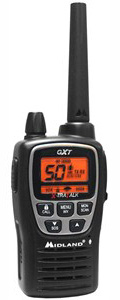
 You may have noticed that most of the consumer two-way radios you see around advertise a range of up to 30 miles. The truth is, consumer FRS and GMRS radios will not even provide close to the advertised "maximum range".
The range that a two-way radio advertises is the range that the radio should get in "ideal" conditions. Ideal conditions are line of sight, such as from a mountaintop to a valley below -- no interference at all. Most likely, you will not be using the radios in these circumstances! You will probably want two-way radios for things such as hunting, skiing, malls, car trips or vacations. Under these normal conditions, the range of the radio will be limited because of obstructions, such as trees, hills, or buildings. These obstructions block the signal and dramatically reduce the range of a two-way radio.
So what type of range can you expect from your radio? Usually half a mile up to two miles, depending upon your terrain and the power of your radio. In the same environment, a 2 watt radio with a long antenna would provide considerably more range than a half watt radio with a short antenna.
When choosing a radio, it is very important to consider both the amount of range that you need and the environment in which you will be using the radios. Naturally, you wouldn't have as many obstructions in a football stadium as being in the middle of a heavily wooded area. For use in a stadium you would likely be fine with a small, one watt radio. In a wooded area, however, that same radio may not provide sufficient range. These are things that you need to take into consideration when choosing which two-way radio is right for you.
Related Resources
GMRS Radio Range Chart
Getting The Most Range From Your Radio
The Two Way Radio Show TWRS-05 - Radios in Range
The Two Way Radio Show TWRS-45 - The Truth About GMRS Radio Range
Radio 101 - The truth about FRS / GMRS two way radio range
How To Optimize Range for Motorola Talkabout Two Way Radios
Call "simplex" I have talked 10 miles max 60 miles. And using the extensive ham radio repeater network you can talk world wide. The most popular is the 2 meter band 144 MHz to 148 MHz. This would be your permanent solution to your radio Comunication needs. This license is for personal hobby use and cannot be used for business. The entry level license is easy to study for. A little effort will be worth the time. Each radio operator will need a ham radio license however. Well worth the time investment. The license is about $25.00 for ten years. Google
"arrl" on the Internet for more info.....
Lyndon.
Ham call sign K7XV
Or is "miles" just hype and the only real difference might be just some of the features, e.g. "waterproof" or something else?
For a more in-depth discussion on range, listen to .
Cruise ships are quite large with a number of decks and a lot of steel to get in the way, so you want a radio that can give you optimal performance in those areas. There are a lot of activities on cruise ships so chances are you will be out and about a lot more than in your cabin, so it's a good idea to choose radios that work with both rechargeable and displosable batteries and to bring along extras. You will be surrounded by water and it can be humid. Salt water can also be corrosive, so radios that can weather a cruise is a wise choice.
Before making a purchase, you may want to listen to The Two Way Radio Show Episode 19 - Cruising With Radios first. We went into great detail on this very topic and made some recommendations on specific radios, such as the Midland GXT1000VP4 and the Motorola MR350R.
3. If you are doing point to point like a Generator shed to the Main building can not beat the old military field phones 2 wires pick up the phone turn the crank and alert the other phone no batteries sound powered hand sets! Hope this helps, Tom
The real question is what we are comparing the marine radios to. Are we comparing them to FRS/GMRS radios or business radios? If we are talking about consumer FRS/GMRS radios, a marine radio will provide greater range, since consumer radios offer well below one watt on the low end and max out at 5 watts on the high end.
While mobile marine radios usually offer higher wattage, handheld portable marine radios are typically around 5 watts, about the same wattage as a typical business VHF or UHF handheld radio.
Thanks,
Joe
I am looking for a set of good two -way radios to use for regatta management, on an inland river. Ideal range would be 5 miles, assuming conditions similar to a wooded area, without line of site for more than a mile at any given distance. Any suggestions? I was looking at the Midland or Motorola product lines. Thank you!
Ellen