
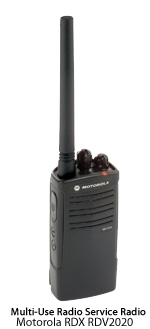
 Do you need a high powered two way radio, but don't want to deal with the hassle of licensing? MURS may be the answer, particularly if you plan to use the radio outdoors where VHF frequencies are most effective.
The Multi-Use Radio Service (MURS) is a two-way radio service consisting of five frequencies in the VHF spectrum. Established by the U.S. Federal Communications Commission (FCC) in the fall of 2000, MURS is a radio service allowing for "licensed by use" operation, meaning that a FFC issued license is not necessary to operate a MURS transmitter. The FCC formally defines MURS as "a private, two-way, short distance voice or data communications service for personal or business activities of the general public".
There are some limitations to MURS: radio power is limited to 2 watts, MURS stations may not be connected to the public telephone network, radio repeaters are not permitted, and the highest point of any MURS antenna must not be more than 60 feet above the ground or 20 feet above the highest point of the structure on which it is mounted.
Since MURS exists within the VHF spectrum, it has the potential to become very popular among the traveling community and outdoor enthusiasts. VHF characteristics are ideal for short-distance ground communication, with a range generally somewhat farther than line-of-sight. Although there are limitations on transmitter power output and antenna height, there are no restrictions on the use of external antennas. The range for vehicle-to-vehicle communications with MURS can be much greater than that for the Family Radio Service (FRS). Outdoor activities are benefited by the increased range over the FRS, allowing for base camps to utilize antennas to stay in contact with campers and emergency personnel.
MURS operation is authorized anywhere a CB station is authorized.
- Within or over any area of the world where radio service are regulated by the FCC
- Any other area of the world, except within the territorial limits of areas where radio services are regulated by either an agency of the United States other than the FCC or any foreign government (Subject to either parties rules)
- Aboard any vessel of the United States, with the permission of the captain, while the vessel is traveling either domestically or in international waters
MURS operation is not authorized aboard aircraft in flight.
MURS stations may transmit voice or data signal as permitted in FCC regulation Section 95.631.
Determined quickly whether a radio is legal to use on MURS:
- If the radio is Part 95 certified and operates on MURS frequencies
- If the radio was Part 95 certified prior to November 12, 2002 and transmits no more than 2 watts, and has no external control to increase power above 2 watts and only operates wideband on the 154 MHz frequencies (all parts must be true)
- If the Radio was Part 90 certified prior to November 12, 2002 and transmits no more than 2 watts and has no external control to increate power above 2 watts and does not narrowband on the 151 MHz and 154 MHz frequencies or narrowband on 151 MHz and wideband on 154 MHz frequencies (all parts must be true)
The following are the frequencies authorized for use by the MURS:
| Frequency | Authorized Bandwidth |
|---|---|
| 151.820 MHz | 11.25 kHz |
| 151.880 MHz | 11.25 kHz |
| 151.940 MHz | 11.25 kHz |
| 154.570 MHz (also part of business band) | 20.00 kHz |
| 154.600 MHz (also part of business band) | 20.00 kHz |
Click here for a list of radios that we currently offer supporting the MURS frequencies.
Related Resources
The first mobile MURS radio from Wouxun is here!
Best MURS Two Way Radios of 2020
Looking for a MURS Compatible Radio?
MURS Capable Two Way Radios
Motorola Releases Two New MURS Radios
Introducing the Wouxun KG-805 Professional GMRS and MURS Radios
The Two Way Radio Show TWRS-11 - All About MURS
The Two Way Radio Show TWRS-145 - New GMRS and MURS Radios
MURS radios were used widely in the 1980's where you requested use of freqs use through FCC .
There was a small fee and were good for few years.
Used hand held radios but company mainly used 25 watt mobils in trucks for past owned
lumber yard 25 mile radius in area. We Had Motorola Base and antenna at 60 ft
which we were athorized useas per all old records show start of 1989 at
up to 50 watts mobil or base. we would recieve a renewal and pay fee every few years.
Last was 1998. Still have few these maxtrac's programed to 154.600 thinking using
not as murs bussiness anymore but on farm.
There has to be more power then 2 watts on mobil radio's?
If not when they change this?
If not GMRS with UHF band Mobils a possibilty vertex, kenwood or motorola .
Lots bad reviews of cheap china radios that are over priced.
Please put commeny on post. thank you.
I'd just get a 40 to 50 watt Chinese mobile vhf ..they all cover expanded freq including MURS and enjoy real good range for great price !
Even with CTCSS (A.K.A. "PL" tone) installed/enabled, it is also against the FCC rules to transmit over anybody else who is occupying the channel you are using.
So, it is in your best interest to A) Install the radio(s) with a means to disable the CTCSS upon lifting the microphone, or B) Press the MON(itor) button for a few seconds before transmitting, to (hopefully), ascertain whether the frequency is in use.
It has to be a literal life and death situation. Even then you're pushing it. I would recommend you either setup a CB relay group (no license, cheap equipment, and good range). Next best is GMRS because it gives you 2 possibilities: low power with a power mobile radio for $15 that can be used to listen with. Or pay for a $50 license go with 50 watts legally to cover a 2-3 miles. Your best option is setup a HAM group for the best quality and distance.
There is also this law here which is a law regulating fixed microwave radio services:
§ 101.203 Communications concerning safety of life and property.
(a) Handling and transmission of messages concerning the safety of life or property which is in imminent danger must be afforded priority over other messages.
(b) No person may knowingly cause to be transmitted any false or fraudulent message concerning the safety of life or property, or refuse upon demand immediately to relinquish the use of a radio circuit to enable the transmission of messages concerning the safety of life or property which is in imminent danger, or knowingly interfere or otherwise obstruct the transmission of such messages.
For a more in-depth discussion, listen to The Two Way Radio Show Podcast TWRS-11 - All About MURS.
Do you sell Motorola (or other quality brands) of MURS portable or handi-talkie radios?
If you do and could advise me of the cost per radio plus 2 or 3 spare battery packs per radio, I would appreciate it. if holsters or belt clips are available, that we be helpful, also.
Col. Randall Smith, KF5YMT/AAR6KQ, Commander
Civil Defense Nationwide Emergency Communications Network
Thank You
ground? I realize I probably will put on external antennas. I do not
know much about MURS.
Thank You,
Jim